
Should you eat fish?
Or take fish oil?
Is fish oil a poison?
Or the secret to a long and healthy life?
Are fish an essential part of a balanced diet?
Or mercury and pollutant-riddled, parasite-spreading “food” that we should leave to the sharks and Orcas?
These are important questions for us to answer.
Let us dive in to this ocean of controversy (pun intended).
The Problem with Fish
Fish have been a staple of human diets worldwide for generations. They are touted as one of the healthiest foods on planet earth. Yet they have undoubtedly become one of the most dangerous.
Fish: The Good
Research conclusively shows that higher levels of omega-3 fatty acids are associated with longer life and greater vitality. Fish are rich in omega-3’s. They are our chief dietary source of these fatty acids.
Fish are rich in minerals like copper, magnesium, potassium, zinc, selenium, and iodine. There is a sweet spot for consumption of each of these minerals, but most people do not get enough of any of them. Fish help us to optimize our mineral intake.
Fish are rich in protein. Cod, for example, has far more protein than beef or pork. Most people do not eat enough protein, and fish can help them solve this problem.
Fish: What’s Fishy
Big fish (shark, swordfish, tuna, and King mackerel) are extremely high in mercury. Other popular fish, like halibut, have moderate quantities of mercury. In The End of Autoimmunity, I share a case study of a man poisoned by his seafood habit. I have more stories like that one than I can keep track of.
Fish are fishy. Many patients do not like fish. Perhaps this is because fish do not freeze and travel as well as meat. I suspect it is because people today do not grow up eating much, if any, fish. Regardless, fish spoil easily and need to be preserved carefully.
Farmed fish are suspect. They are being treated with all kinds of chemicals (pharmaceuticals) in order to keep them alive in captivity. Producers color them with artificial dyes to make them more appealing. Are farmed fish as healthy as wild fish? Are they more contaminated with chemicals? I do not know. I am open to the idea that farmed fish can be part of a healthy diet.
Fish are intense. Because they are rich in minerals, they can be too much for some people. They are not my first choice to nourish people who are struggling with their digestion. I only recommend fish to patients who are robust and have a strong stomach.
The Problem with Shellfish
Shellfish fall into two categories - crustaceans and mollusks. Crustaceans include shrimp, crabs, and lobsters. They move around. Mollusks include clams, oysters, mussels, and scallops. They do not move around.
There are a few problems with shellfish.
First, many patients won’t touch them. This may be due to taste, texture, allergies, or concerns about quality and safety.
Second, most patients don’t have access to high-quality sources on a regular basis. Frozen fish at the grocery store is the norm for most people, and this is not particularly appetizing or exciting.
Third, contamination can become a major problem. This is highly local. Almost no one is testing shellfish for the environmental chemicals and toxins that are common in our modern world. Even without local contamination, heavy metal levels in shellfish are high.
Fourth, shellfish have a variable content of omega-3’s. Oysters are rich in omega-3’s, but scallops and shrimp are poor.
I still eat molluscan shellfish (once a week at most). I tend to eat mostly shrimp and scallops.
Fish or Fish Oil?
Why Take Fish Oil?
Controversy abounds about fish oil. Many studies of fish oil supplementation have shown benefit, but many have shown no benefit.
Here’s why I often recommend fish oil to our patients.
Our fish oil is Dr. Stillman’s Omega + (you can purchase here).
First, it is associated with a lower risk of dementia and better cognitive function.
Second, we may question the quality of fish oils in the negative studies as well as the validity of the studies based on duration. For example, it might take twenty years to document a statistically significant difference between a treatment group taking fish oil and a control group taking a placebo. Besides which, what placebo do you give the control group? Every oil that would look like fish oil has medicinal properties!
Third, most patients do not eat enough fish to reach 2-4 grams per day of fish oil. If you’re not eating fish and omega-3 rich nuts and seeds (flax, chia, and walnuts), you’ll likely be deficient in omega-3’s. Don’t guess your level - test it. Fatty acid blood testing is worth it.
My main criticism of fish oil is that fish oil does not provide me with the minerals I would get from eating fish. I address this by eating nuts and seeds, which are rich in all the minerals that fish are rich in. This is another reason I tend to emphasize nuts and seeds to my patients.
My Routine
I prefer to get my omega-3’s from food.
This is just my preference. Here’s how I do it:
Nightly smoked salmon and/or herring in dill sauce (1 ounce total).
Nightly keta salmon caviar (<10 grams per night).
Daily Dr. Stillman’s Detox Powder smoothie. This includes 12 grams of dry flax seed.
Salmon once weekly, 5-7 ounces.
Scallops and/or shrimp once weekly, 5-7 ounces.
And I eat 1-2 ounces of nuts and seeds most days (a variety of them).
Here are my omega-3 levels from this month:
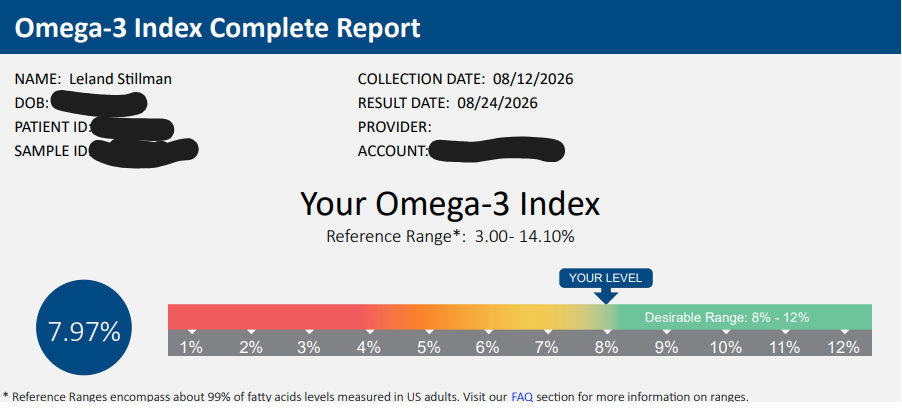
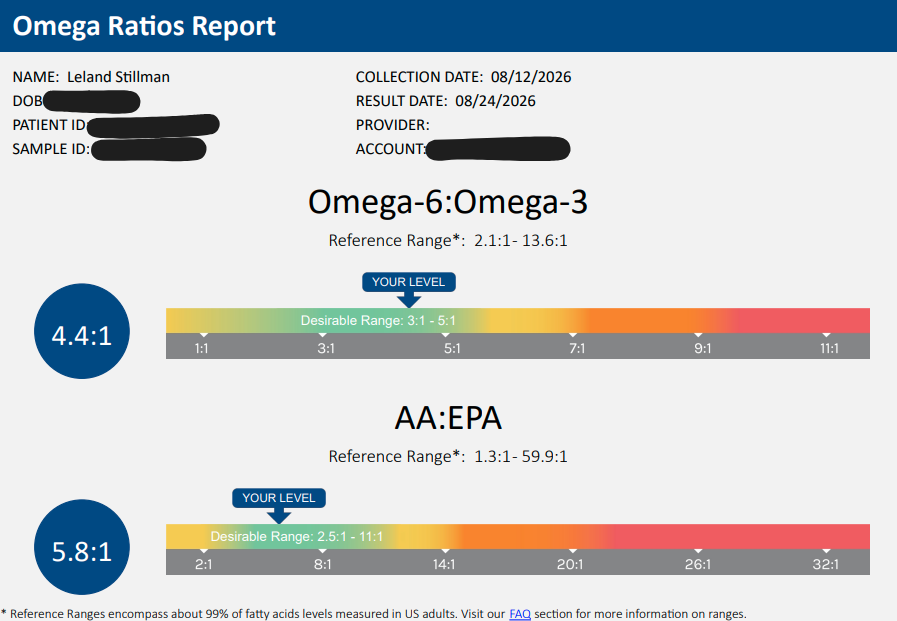
These are nearly perfect. So I know this works.
If you’re not prepared to:
Eat huge amounts of seafood
Consume flax, chia, or walnuts regularly
Police your diet for omega-6-rich foods (1-2 ounces of nuts and seeds max)
Police your diet for refined seed oils
Then you might choose a supplement.
Ours is Dr. Stillman’s Omega + (available here).
Your Next Step
If you found this helpful, book an evaluation with a member of our team.
During the evaluation, we’ll:
Review your history and current symptoms
What you’ve tried, what’s worked, and what hasn’t
Get you clarity on where to go next, whether that’s becoming a member of our practice or a referral to a trusted partner of ours
Book your evaluation today. If you’re tired, foggy, and inflamed, we’d love to help you reclaim your health.
Until next time, be well,
Dr. Stillman