
Heavy metals are driving our modern healthcare crisis, from childhood illness to dementia, as well as the societal decay and collapse we see all around us.
Before you write this off as a conspiracy theory, take a look at the data and historical precedent, including real heavy metal testing results from patients in our practice.
Every week I see heavy metals pour out of patients at our practice. We run thousands of metal and mineral tests in our practice each year, and we see the fall-out from years of environmental pollution and processed food consumption.
Here’s what we see in patients with heavy metal toxicity:
Fatigue
Brain fog
Anxiety
Depression
Skin issues
Gut issues
Sleep issues
Weight that won’t budge
They wind up with diagnoses like fibromyalgia, chronic fatigue syndrome, generalized anxiety disorder, major depressive disorder, psoriasis, eczema, irritable bowel syndrome, and more.
They usually go from doctor to doctor looking for answers, or spend years of their life chasing different theories on the internet as to why they’re tired, foggy, and inflamed.
I’ve spent my career helping these patients reclaim their health, and metals are huge piece of the puzzle for most of these patients.
Take the Heavy Metals Burden Questionnaire
These are the questions we ask in our clinic to estimate whether metals are likely a major driver of your symptoms.
Here’s a toxic metals panel from a young professional in Miami who was struggling with insomnia, gut issues, and intrusive thoughts:
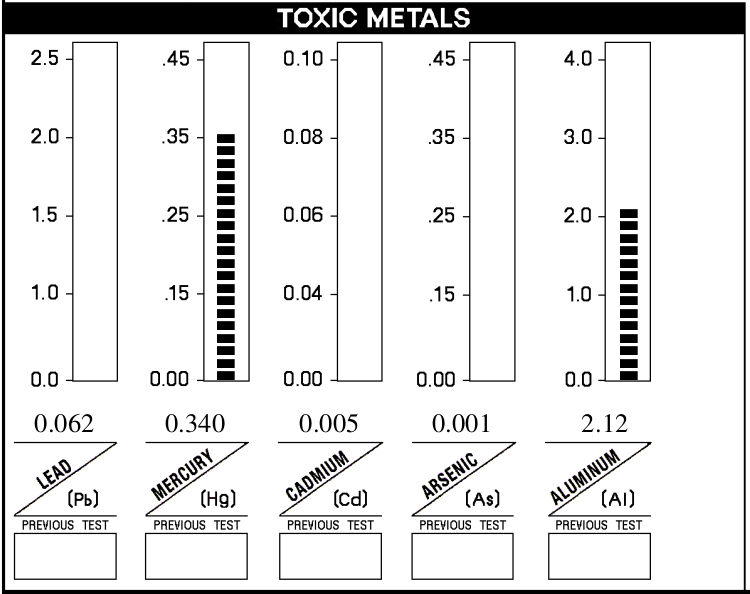
His mercury level is ten-fold higher than most patients at our practice.
This problem is not new. Civilizations have been poisoning themselves with metals for thousands of years. Historian and chemist Jerome Nriagu, PhD, argued that chronic lead exposure from pipes, cookware, and sweeteners quietly damaged the health and judgment of Roman elites (Lead and Lead Poisoning in Antiquity, 1983). At the height of the British empire, “mad hatters” went insane from mercury used in hat making, while social elites like Isaac Newton were exposed through mercury‑containing medicines and experiments. Newton died young of kidney stones induced by mercury poisoning.
We’ve been misusing metals for generations and it’s coming home to haunt us.
There are five toxic metals that drive much of our modern epidemics of inflammatory diseases, including autoimmunity and cancer.
Take the quiz to find out what your metals burden is.
The Five Big Metals
The five most common toxic metals are:
Mercury
Aluminum
Cadmium
Arsenic
Lead
They are dangerous not only because they are toxic, but because they bioaccumulate and many have half‑lives measured in years or decades, especially in bone and organs.
That means:
A weekly tuna habit can quietly raise your mercury for years.
An antacid habit can load you with aluminum by the pound.
Dark chocolate, cigarettes, and certain jobs can build a slow cadmium overdose.
Rice, well water, and overseas herbs can drip arsenic into your system.
Childhood lead exposure can come back out of your bones during menopause, pregnancy, weight loss, or stress.
This is why we focus on eliminating heavy metals in our daily practice. Here are case studies to illustrate why.
Mercury: “Healthy Fish” That Isn’t
Top modern sources:
Large predatory fish (tuna, swordfish, shark, king mackerel)
Mercury amalgam dental fillings
Industrial emissions that contaminate air, soil, and food
The EPA “safe” level for methylmercury is about 7 micrograms per day for a 150‑pound adult. A single 3‑ounce serving of swordfish can contain over 80 micrograms.
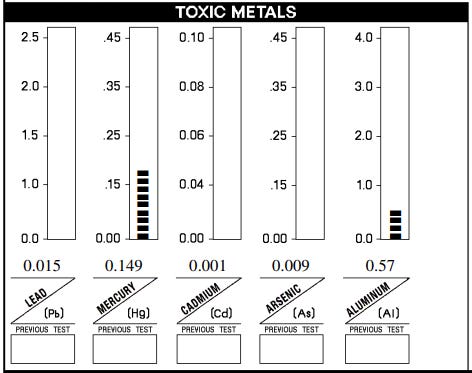
Richard’s story: a successful executive with autoimmune hyperthyroidism who loved fine dining and often ordered swordfish, tuna, Chilean sea bass, and other high-mercury fish. He also had a mercury filling in one tooth.
His autoimmune hyperthyroidism went into remission with a short course of medication, supplements, and light therapy. He relapsed a year later, and at that point he took my advice to get his amalgam out more seriously.
Here’s his hair test, showing excess mercury:
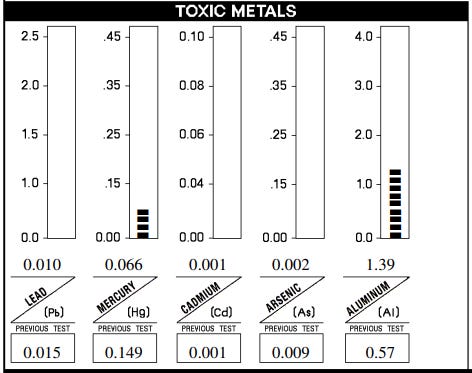
Here’s his repeat test, showing a decline in mercury after our first round of treatment and a rise in aluminum. His aluminum is rising because, now that he’s got less mercury on-board, he can start to eliminate aluminum that is also part of his problem.
Even if you don’t eat high-mercury fish or have mercury amalgams, you are still exposed to mercury on a daily basis. It’s unfortunately in our air, water, and food thanks to decades of pollution.
Here’s how much mercury the average American absorbs over time, assuming they have no amalgams and only eat tuna once a month:
Amount/years
1.4 mg/5 years
2.7 mg/10 years
5.5 mg/20 years
8.2 mg/30 years
Here’s what happens when you add one moderate-sized mercury (silver) amalgam:
Amount of mercury absorbed/Years
2.28 mg/5 years
4.56 mg/10 years
9.12 mg/20 years
13.68 mg/30 years
What’s a few milligrams of mercury, though? Do we really need to worry about these tiny exposures?
In an autopsy study of the brains of Alzheimer’s disease patients, mercury concentrations in the lobe associated with memory (the temporal lobes) were nearly three-fold higher than in control brains.
The estimated difference in mercury between the two groups?
Just twenty five micrograms.
The average American with a filling absorbs nearly 100 times that in 5 years. Why don’t they all get Alzheimer’s disease? It’s not going straight to the temporal lobe, it’s being distributed around the body, where it can cause heart attacks, strokes, cancers, and more on its way to causing Alzheimer’s disease.
Most patients with significant mercury burden will be diagnosed with some kind of autoimmune or inflammatory disorder on their way to dementia. We have many more stories like Richard’s in the practice.
Take the Heavy Metals Burden Questionnaire
These are a few simple questions we ask in our clinic to estimate whether metals are likely a major driver of your symptoms.
Aluminum: The Metal of Our Age
Aluminum is less acutely toxic than mercury or lead, but what it lacks in toxicity it makes up for in quantity. We are exposed to much, much more aluminum today than mercury.
While we’ve made progress eliminating mercury, lead, and other heavy metals from the food supply, our aluminum exposures are worse than ever thanks to clever lobbying by the aluminum industry.
Typical sources:
Processed foods and baking mixes
Canned drinks and energy drinks
Antacids and buffered aspirin
Some personal care products (antiperspirants, some cosmetics)
Certain medical products
The average American consumes 7-9 milligrams per day from food and water alone, every single day.
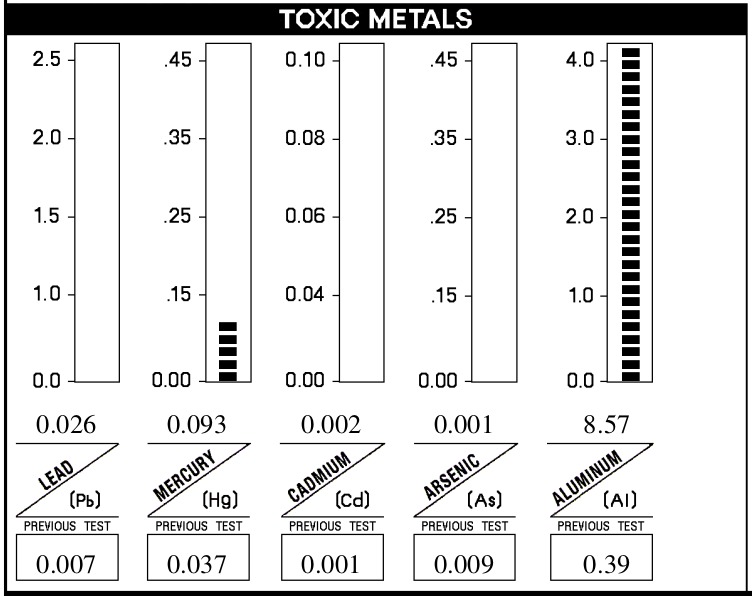
Emily’s story: a woman with myasthenia gravis, fatigue, and infertility. Her first hair test looked almost normal. After we restored key minerals and supported detox pathways, she developed brief “flu‑like” reactions. Her repeat hair test showed aluminum up 20‑fold and mercury tripled as her body finally pushed metals out. Over 18 months she went from hospitalized and struggling to conceive to stable, energetic, and pregnant.
Here’s her mercury and aluminum elimination:
She recorded a podcast with me about her journey. You can listen to it here:
Here’s how much aluminum the “average” American absorbs over time:
Amount/years
12.8–16.4 mg/5 years
25.6–32.9 mg/10 years
51.1–65.7 mg/20 years
76.7–98.6 mg/30 years
This is “average.” This doesn’t include the aluminum many healthcare workers and military members receive routinely in vaccinations.
“But 100 mg doesn’t seem like much.”
Let’s put this in perspective.
Chris Exley, PhD, demonstrated that aluminum concentrations in patients with Alzheimer’s disease and multiple sclerosis of 2.8 and 3.2 micrograms per gram, respectively. With an estimated brain weight of 250-300 grams, that’s 0.7-1.0 milligrams of aluminum spread across the brains of these patients. Aluminum levels in healthy controls were much lower than this.
Before these patients develop Alzheimer’s disease, they usually develop fatigue, brain fog, thyroid disease, gut issues, skin issues, and more.
Can you guess why Alzheimer’s and multiple sclerosis are increasing in prevalence and severity, and are more severe at younger ages? It’s no mystery to those of us who are familiar with the metal toxicology literature.
Take the Heavy Metals Burden Questionnaire
These are a few simple questions we ask in our clinic to estimate whether metals are likely a major driver of your symptoms.
Cadmium: Smoke, Work, and “Healthy” Chocolate
Key sources:
Cigarette or marijuana smoke
Metalworking, batteries, smelting
Leafy greens, grains, legumes, shellfish
Cocoa, chocolate
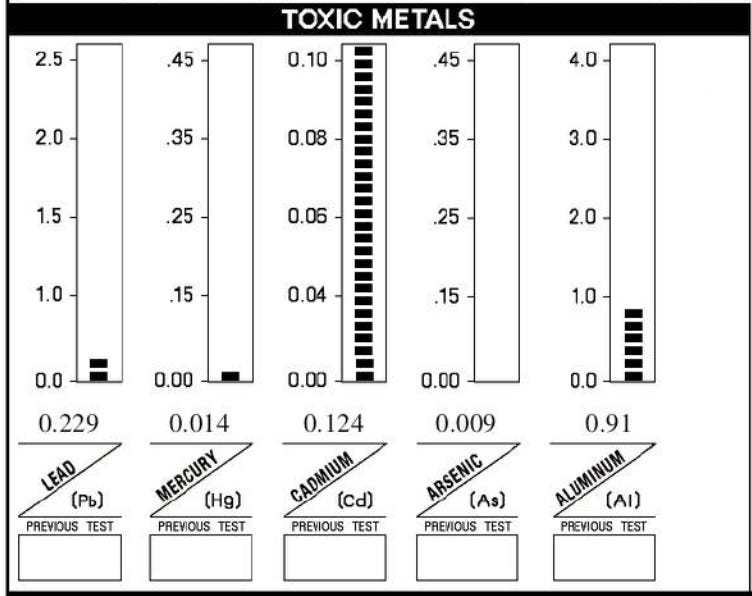
Paul’s story: a mechanic who was told he just had multiple sclerosis turned out to have the highest cadmium we had ever seen. With the right protocols and a break from work, he’s regaining his ability to function, think, and be a husband and a father. Here’s his first test:
Arsenic and Lead: Old Problems That Never Went Away
Arsenic shows up in:
Groundwater (especially private wells)
Rice and rice products
Some fruit juices
Seaweed, some seafood, some poultry
Herbs and supplements grown in contaminated soil
Lead is nearly universal:
Older paint and dust
Old plumbing and service lines
Contaminated soil near roads and industry
Some imported candies, spices, hair and cosmetic products
Lead’s half‑life in bone is 10–30 years. A woman can absorb it as a child, store it in her skeleton, and then release it into her bloodstream during pregnancy, menopause, or major weight loss, exposing herself and her baby decades later.
We have seen severe lead elevations linked to certain hair products and cosmetics, enough for patients to pursue legal action.
Here’s an example:
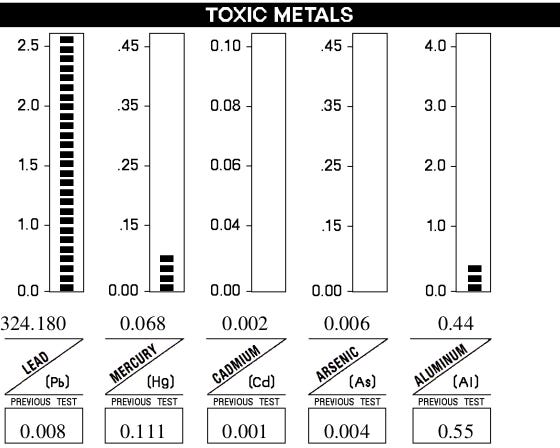
Three men in our practice were using this product - this problem is more common than people realize.
Beyond Hair Testing
So far, I’ve shared hair test results with you. We’re launching a Heavy Metals Diagnostic Challenge with this post.
You get early access to it as a subscriber here. You’re the first to find out about it - thank you for subscribing.
Take the quiz to find out if the challenge is right for you.
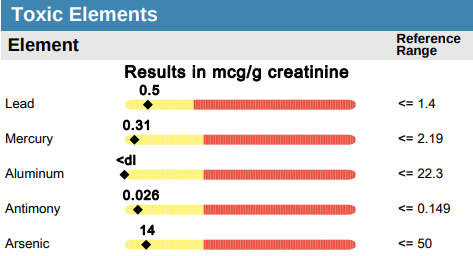
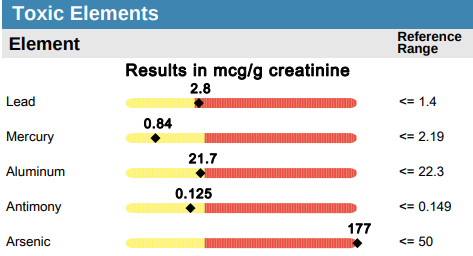
To evaluate the body’s total metal burden we run a urine challenge test, where we give a small dose of an organic acid to provoke metals from a patient’s body in their urine.
Here’s a urine heavy metal panel without provocation:
And with provocation with the organic acid:
What are your heavy metal levels?
Are you on track for Alzheimer’s, multiple sclerosis, heart disease, or a stroke due to metals you’ve accumulated over the years?
Our quiz is your first step to finding out.
Take Our Heavy Metals Burden Questionnaire
In our practice, we have a few simple questions to determine who has the highest heavy metals burden. We know that eliminating these metals and replacing them with minerals like zinc is the key to healing these patients.
Take the test here:
Take the Heavy Metals Burden Questionnaire
These are a few simple questions we ask in our clinic to estimate whether metals are likely a major driver of your symptoms.
When you complete it, you will get:
A simple score showing your likely exposure level
A short explanation of what that score means
If your score suggests a significant burden, we’ll show you what testing would look like to see exactly what your burden is and what to do about it.
Until next time, be well,
Dr. Stillman