
Heavy metals are one of the primary driving forces behind our modern epidemic of autoimmunity, as I have written about in my book, The End of Autoimmunity, available September 15th.
Enter my giveaway for a chance to win a free ebook copy of my new book.
If you’re tired, foggy, and inflamed, then you undoubtedly have heavy metals within your body that are part of the problem.
We have been polluting the world with heavy metals since we first discovered how to work metal into tools. Before the advent of metallurgy, the only sources of heavy metals in the biosphere were volcanic eruptions and the rare asteroid strike.
Heavy metals are toxic to life. This is true from single-celled organisms up to the largest mammals on earth, like elephants and whales. Heavy metals tend to “bio-accumulate.” This is a ten dollar word for a simple concept. The larger the organism and the bigger its prey, the more metals it will accumulate. The highest levels of mercury in fish are found in large, carnivorous fish like sharks, swordfish, or tuna. As these fish eat more and more fish over the course of their lives, they accumulate more and more mercury.
We are no different. You would be shocked to see the difference in mercury levels between people depending on how much fish they eat.
Here are the hair tests of a couple who summer in one place and winter in another. Where they summer, the water is cold and the fish are smaller. Where they winter, the water is warm and the fish are more carnivorous.
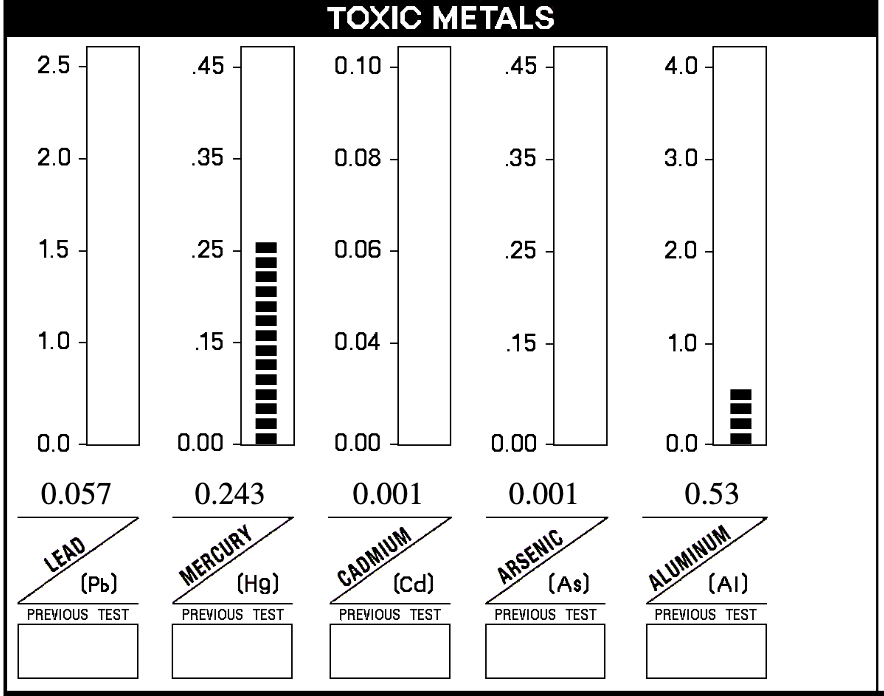
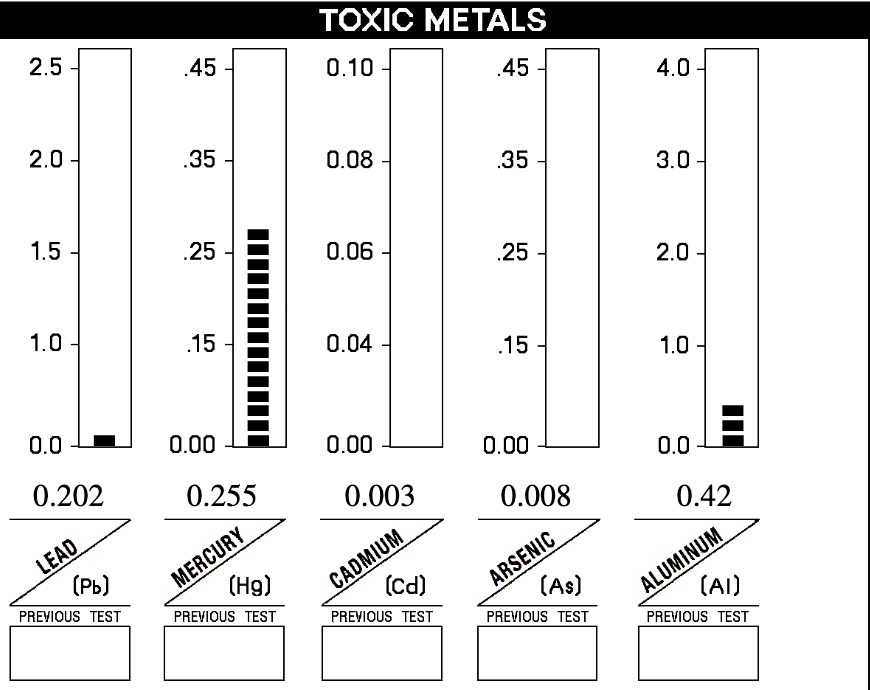
Their hair tissue concentrations vary by almost 100% based on where they are living.
Why do I start with mercury? Because it is the most toxic heavy metal, because it is strongly tied to autoimmunity, and because you can radically reduce your exposure with a few simple choices. I write more about this in my book.
Mercury is one of the root causes of autoimmunity, but by no means is it the only heavy metal that drives autoimmunity.
How Toxic Are Heavy Metals?
Here is how much of each heavy metal it would take to kill a 180-pound man, based on lethal dose studies:
Metal
Lethal Dose (approximate)
Mercury 200 mg
Arsenic 1,000-1,500 mg
Cadmium 7,000-9,000 mg
Lead 37,000 mg
Aluminum 285,000 mg
To give you some perspective, one milligram is a speck you would struggle to see on your countertop. One microgram is one-thousandth of that.
Mercury stands out. You need about 7 times more arsenic to kill you, 35 times more cadmium, and over 1,400 times more aluminum. This is why mercury has been called the most potent neurotoxin on earth.
But here is what makes this terrifying. According to CDC biomonitoring data:
Mercury is detectable in 60-90% of Americans
Lead is detectable in essentially 100% of us
Cadmium is found in 50-70% of adults tested
Arsenic is detectable in over 70% of adults
We are all carrying these metals in our bodies right now.
The Half-Life Problem
Acute poisoning is not the real danger. The real danger is accumulation over time.
Here is how long it takes your body to eliminate half of the heavy metals you have absorbed:
Mercury (blood) 50-80 days
Mercury (brain) Years to indefinite
Cadmium (whole body) 10-30 years
Lead (blood) 28-36 days
Lead (bone) 10-30 years
Aluminum (bone) 6-20+ years
Read that again.
Cadmium has a half-life of 10-30 years. If you absorb cadmium today, half of it may still be in your body when your children graduate from college.
Your bones act as a reservoir for lead. Every time you get stressed, lose weight, go through menopause, or break a bone, that stored lead re-enters your bloodstream.
This is why we see patients who have been “healthy” for years suddenly develop autoimmune conditions. The metals were accumulating silently the whole time.
What We Are All Consuming
The average American absorbs heavy metals every single day, whether they know it or not.
Here’s the average daily intake of a modern American:
Mercury 2-4 mcg (10+ mcg in high fish consumers)
Lead 2-30 mcg
Cadmium 10-30 mcg
Arsenic 10-50 mcg total (3-20 mcg inorganic)
Aluminum 3-7 mg (3,000-7,000 mcg)
These numbers might not seem like much, but consider that you are absorbing these metals every day, year after year, decade after decade. And some of them take 10-30 years to eliminate.
Accumulation is inevitable. Supplementation with minerals and supporting the body’s detoxification of these metals is now vital to life.
Mercury: The Most Potent Neurotoxin
The top sources of mercury in our modern world are:
Carnivorous fish (tuna, swordfish, shark, king mackerel)
Mercury amalgam dental fillings
Industrial emissions that contaminate air, soil, water, and food
Here is how much mercury you consume from common sources:
Canned light tuna (3 oz) 10-11 mcg
Canned albacore tuna (3 oz) 30 mcg
Swordfish (3 oz) 84 mcg
Tap water at EPA limit (2 L/day) 4 mcg
The EPA reference dose for methylmercury is 0.1 mcg per kilogram of body weight per day. For a 150-pound adult, that is about 7 mcg per day.
One serving of swordfish contains 12 times the EPA daily limit.
Richard’s Story
Richard came to us with autoimmune hyperthyroidism. He was a successful executive who loved fine dining. High-end steak houses were his thing. When he dined out, which was often, he ordered the best fish on the menu. Swordfish. Ahi tuna. Chilean sea bass. He thought he was eating healthy.
He was poisoning himself.
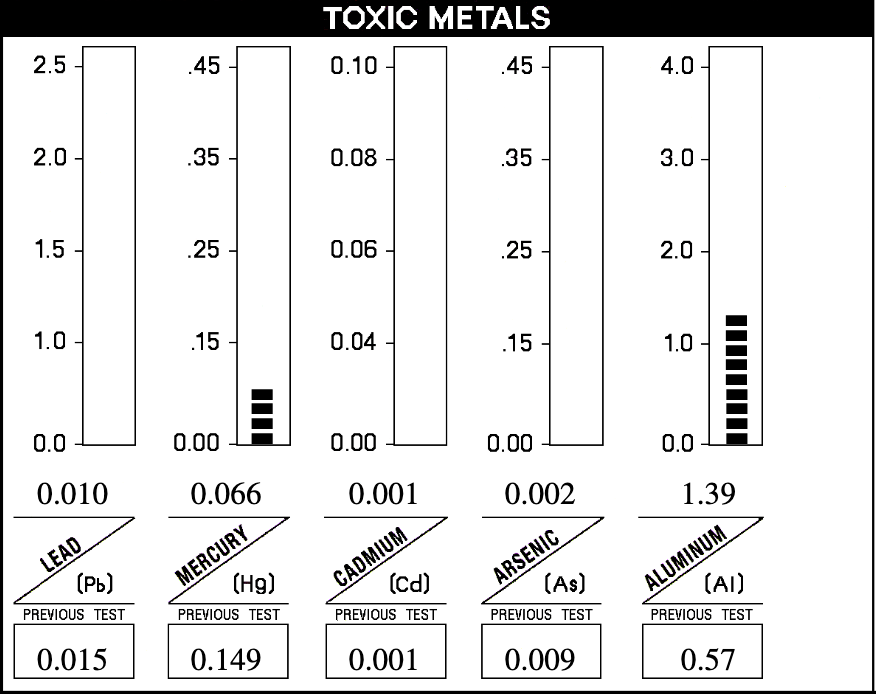
When we tested his mercury levels, they were through the roof. Every business dinner, every celebratory meal, every “healthy choice” at the restaurant had been adding to his mercury burden for decades.
Richard’s case taught me that mercury toxicity is not just a problem for people who eat canned tuna every day. It is a problem for anyone who regularly eats large, predatory fish, whether from a can or from a white tablecloth restaurant.
Here is his first HTMA:
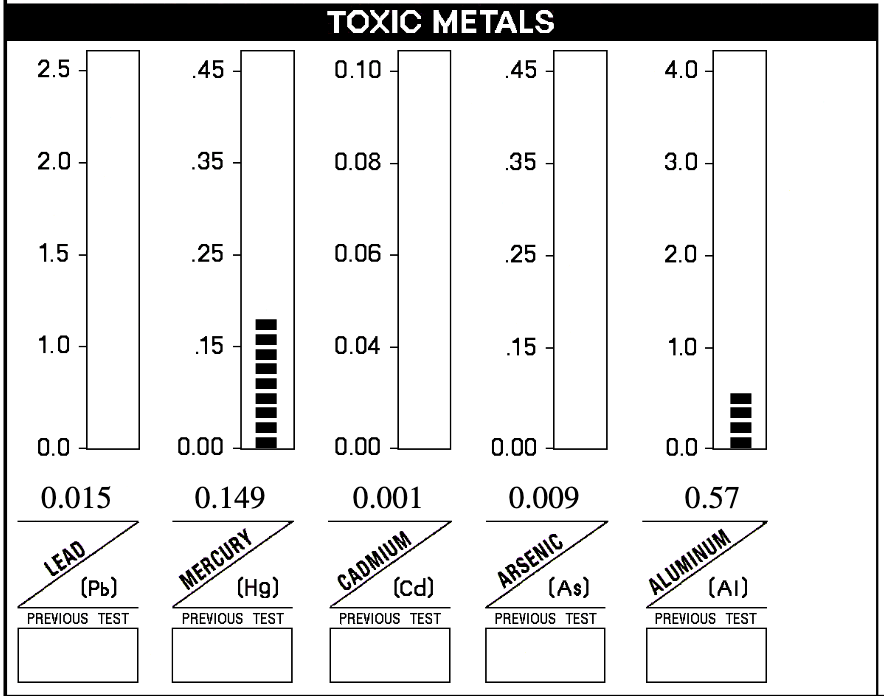
Here is his second HTMA:
The Weekly Tuna Habit
Let me show you how a seemingly innocent habit compounds over time.
Say you eat 8 ounces of albacore tuna per week. Maybe it is a tuna salad sandwich twice a week, or a tuna steak on the weekend. This is well within what most people consider “healthy eating.”
Eight ounces of albacore tuna contains approximately 80 mcg of mercury.
Over one year, that is 4,160 mcg, or about 4.2 mg of mercury.
Over ten years, that is 42 mg.
Over thirty years, that is 125 mg.
The body burden associated with death in the Minamata mercury poisoning cases was approximately 200 mg.
Your weekly tuna habit, continued for three decades, puts you at over 60% of the body burden that killed people in Japan.
Your body does eliminate mercury over time. The half-life in blood is 50-80 days, but some fraction of mercury that enters your brain may persist for years, possibly indefinitely. We do not fully understand how much mercury accumulates in the brain over a lifetime of “moderate” fish consumption.
What we do know is that high fish consumers who sustain intakes of 100-300 mcg per day can accumulate body burdens associated with clinical toxicity within just a few years.
Aluminum: The Most Ubiquitous Metal Toxin
Aluminum is everywhere. It is not as acutely toxic as mercury, cadmium, lead, or arsenic. You would have to consume massive amounts to die from acute aluminum poisoning. This is why regulatory bodies consider it “safe.”
But aluminum is so prevalent in our environment that people are accumulating huge quantities of it over time. The average American consumes 3-7 mg of aluminum per day from food and water alone. That is 3,000-7,000 mcg, every single day.
Here are the doses of aluminum in common items:
Antacid tablet: 104-208 mg
Buffered aspirin (per tablet): 10-20 mg
Soy-based infant formula (per liter): 0.46-0.93 mg
Antiperspirant (per application): 50-375 mg aluminum salt
Canned beverage (leached): 0.2-0.5 mg per liter
I cover this in more detail in my book.
Emily’s Story
Emily came to us with myasthenia gravis. She was infertile, fatigued, and in and out of the hospital. Her first hair test was fairly unremarkable. Several minerals were low and she had no significant elevations in heavy metals. Most practitioners would have assumed heavy metals were not part of her problem.
Soon after starting supplements based on our recommendations, she started having flu-like symptoms and mild skin rashes. We call these detoxification or healing reactions. Patients often have them when the body is eliminating toxins.
What we found on her next hair test was shocking.
Her aluminum level had increased 40-fold. Her mercury had tripled. Her copper had increased five-fold. Her body was finally mobilizing and eliminating these metals from her cells, where they had been trapped for years.
Here’s Emily’s follow-up test:
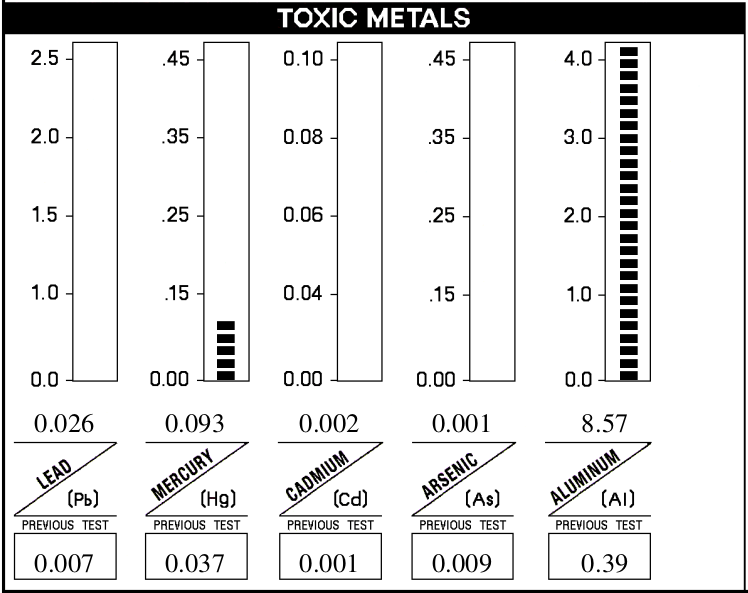
Over eighteen months, Emily went from infertile, fatigued, and hospitalized to symptom-free, full of energy, and pregnant. She is still eliminating aluminum as of this writing.
Emily’s case convinced me that aluminum toxicity is far more common than we realize. The metals hide in our tissues until we give the body the resources it needs to push them out.
The Daily Antacid Habit
Millions of Americans take antacids daily for heartburn or acid reflux.
One antacid tablet contains 104-208 mg of aluminum. Call it 150 mg on average.
If you take one antacid per day for a year, that is 54,750 mg of aluminum. That is nearly 55 grams.
Over ten years, that is 550 grams of aluminum, or over one pound.
Aluminum has a half-life in bone of 6-20+ years. Your body cannot eliminate it as fast as you are consuming it.
The Energy Drink Habit
The record for hair aluminum in our practice is 134 mg%. This was an entrepreneur who was using energy drinks to drive performance. Most of our patients who avoid aluminum-containing products have levels under 2 mg%.
That is a 67-fold difference.
Aluminum leaches from cans into beverages at a rate of 0.2-0.5 mg per liter. The leaching increases with acidity and temperature. Energy drinks are acidic. Cars get hot. That energy drink sitting in your cup holder on a summer day is absorbing aluminum the whole time.
The EPA limit for aluminum in drinking water is 0.2 mg per liter. Many canned beverages exceed this.
If you drink one energy drink per day, you are adding roughly 50-150 mg of aluminum per year just from can leaching, on top of the 1,100-2,500 mg you are already getting from food and water.
“Human exposure to aluminium is the, yet unrecognized, unprecedented threat to the future of mankind.”
- Dr. Christopher Exley
I believe aluminum is driving many of our epidemics of chronic disease, not just autoimmunity. I believe it is behind the epidemics of neurodegenerative disease, allergy, metabolic disorders, heart disease, and more. These are topics for future books.
Cadmium: From the Workshop to the Chocolate Shop
The top sources of cadmium in modern life are:
Cigarette smoke (the primary non-occupational exposure)
Occupational exposure from metalworking, batteries, smelting
Food: leafy greens, grains, legumes, cocoa, chocolate, shellfish
Here is what makes cadmium particularly insidious. The average American consumes 10-30 mcg of cadmium per day from food.
And cadmium has a biological half-life of 10-30 years. It accumulates primarily in the kidney cortex, where it can persist for decades.
Paul’s Story
Paul came to us in 2025 with multiple sclerosis. He is an aircraft mechanic. When we tested his hair, he set the record for cadmium in the practice. Someone has since broken it.
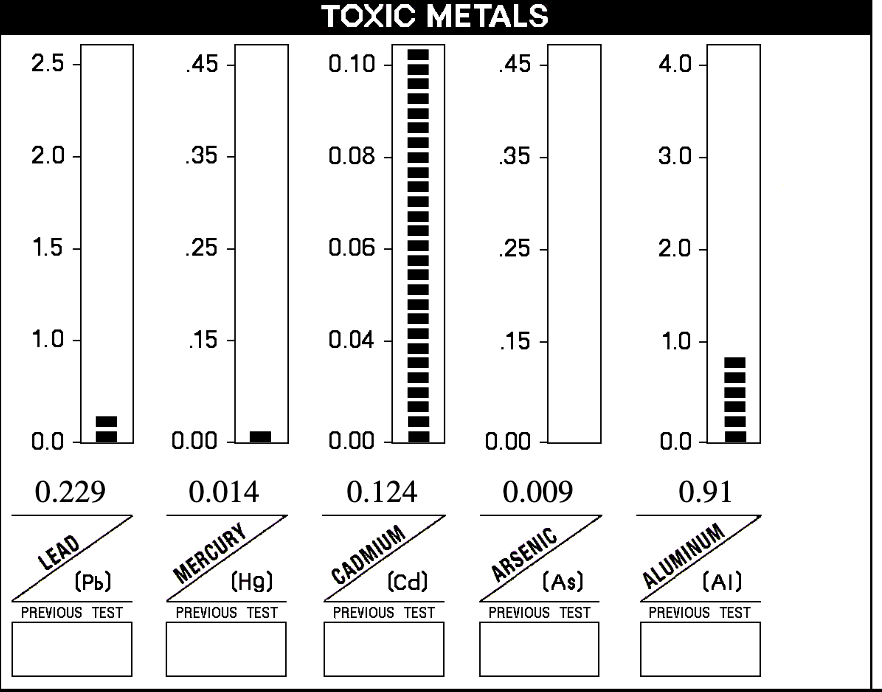
His second cadmium level was even higher. This might seem like bad news, but it was actually a sign of progress. He was not being exposed to more cadmium. His body was finally eliminating what had been stored in his tissues for years. He did not change jobs, so his occupational exposure was unchanged. What changed was his diet, lifestyle, home environment, supplements, and medications. This gave his body the energy it needed to push cadmium out.
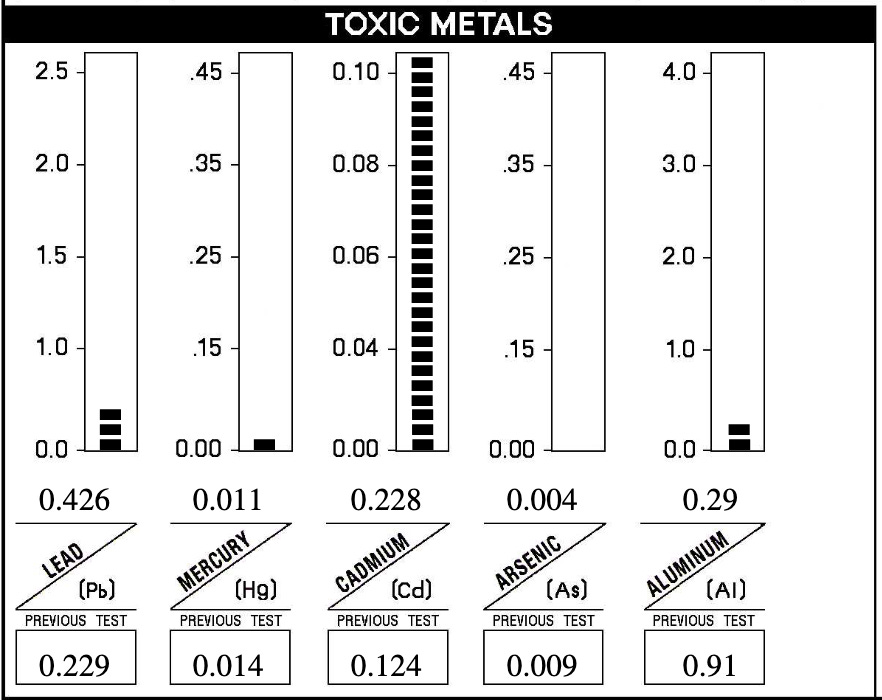
Paul was seeing significant clinical improvements that correlated with his cadmium eliminations. His case taught me that occupational exposure to heavy metals can be a major driver of autoimmunity, and that the body can eliminate these metals if we give it what it needs.
The Weekly Chocolate Bar
Dark chocolate is marketed as a health food. It contains antioxidants. It may support cardiovascular health. What the marketing does not tell you is that chocolate is one of the most concentrated dietary sources of cadmium.
A single ounce of dark chocolate can contain 5-10 mcg of cadmium. A typical dark chocolate bar is 3-4 ounces.
Let us say you eat one 3-ounce dark chocolate bar per week. That is 15-30 mcg of cadmium per bar, or about 20 mcg on average.
Over one year, that is 1,040 mcg, or just over 1 mg of cadmium.
Over twenty years, that is 20 mg of cadmium from chocolate alone.
Now here is where cadmium’s half-life becomes terrifying. With a half-life of 10-30 years, your body eliminates cadmium extremely slowly. After twenty years of weekly chocolate consumption, you have not just accumulated 20 mg. You have accumulated 20 mg minus whatever tiny amount your body managed to eliminate, which is not much.
That chocolate bar you ate in college? Half of the cadmium from it may still be in your kidneys today.
If you smoke, the math is far worse. Cigarettes are the primary non-occupational source of cadmium. Every cigarette adds to your lifetime burden.
Arsenic: From Rice to Well-Water
Arsenic does not get as much attention as mercury or lead, but we see it in our patients. The sources are often surprising.
Arsenic sources:
Groundwater in certain regions (especially concerning in private wells)
Rice and rice products (infant rice cereal limit: 100 ppb inorganic arsenic)
Some fruit juices (apple juice limit: 10 ppb)
Seaweed and some seafood
Poultry (arsenic compounds were used in chicken feed for decades)
Herbal supplements sourced from overseas
Chicken, Herbs, and Arsenic
One of our arsenic cases was a man who loved chicken. He ate it almost daily. He also took herbal supplements medicinally, sourced from overseas.
What he did not know was that arsenic compounds were used in commercial chicken feed for decades to promote growth and prevent parasites. The practice has been banned in recent years, but the legacy remains in contaminated soil and older supply chains.
Herbs sourced from overseas, particularly from countries with less stringent environmental protections control, are frequently contaminated with heavy metals like arsenic. The plants absorb metals from contaminated soil and water. Without rigorous testing, these contaminants end up in the final product.
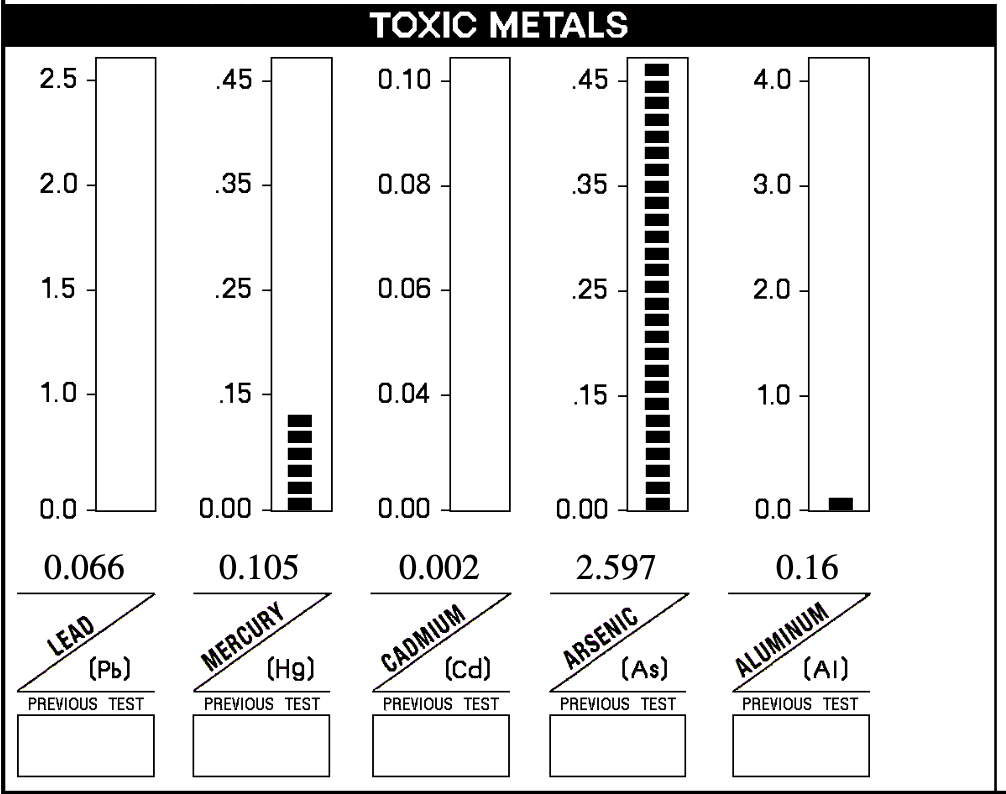
His case taught me to always ask about herbal supplement use and to be suspicious of products sourced from overseas.
Lead: The Bone Reservoir
Lead is detectable in essentially 100% of Americans. We have been exposed to it through paint, gasoline, plumbing, and industrial contamination for generations.
Lead sources:
Legacy lead-based paint and household dust in older housing
Lead in plumbing, service lines, solder, and fixtures
Contaminated soil near roads and industrial sites
Some imported candies, spices, and traditional medicines
Consumer products (see below)
The Old House Problem
Lead deserves special attention because of its storage in bone. With a bone half-life of 10-30 years, lead can re-enter your bloodstream decades after the original exposure.
If you grew up in a house built before 1978, you were likely exposed to lead paint. If you live in an older city with lead service lines, you may be drinking lead every day.
Here is what makes lead uniquely dangerous: pregnancy, menopause, weight loss, and bone fractures can all mobilize stored lead back into circulation. A woman who was exposed to lead as a child can release that lead into her bloodstream during pregnancy, exposing her developing baby to a toxin she absorbed thirty years earlier.
Paul, our aircraft mechanic with MS, saw his lead levels double on his second hair test. Like his cadmium, this was a sign of elimination, not new exposure.
The Hair Product Problem
But the most shocking lead case in our practice did not come from old paint or contaminated water. It came from a consumer hair product.
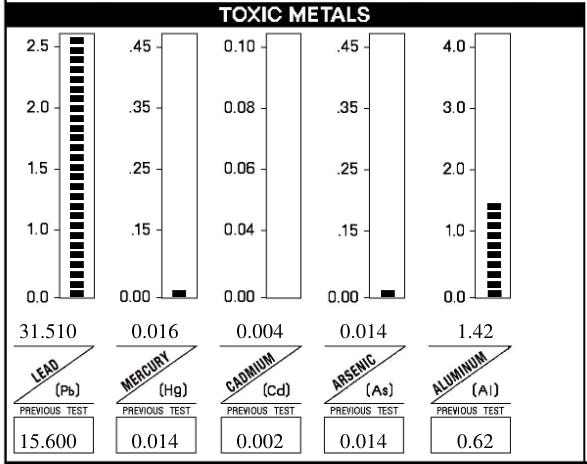
This is just one result, but I have multiple results from three different men documenting these extreme levels of lead. The absorption from these products is unclear, but the elevations in hair testing are unmistakable. One patient developed acute symptoms while using the product and is now pursuing a lawsuit.
Consumer products are not as safe as most people assume. If you are using hair dyes, relaxers, or other chemical hair treatments, you may be exposing yourself to lead and other heavy metals without knowing it.
Your Next Step
We help patients deal with occult heavy metal toxicity all day in our practice. These tests are just a sample of what we see week in and week out.
Most of these patients had no idea that they had a heavy metal problem. They thought they were just tired, foggy, or inflamed. They thought they had diseases like multiple sclerosis, chronic fatigue syndrome, myasthenia gravis, heart disease, high blood pressure, and more, but what was hiding beneath the diagnosis was heavy metal poisoning that was insidiously stealing their health.
If you’re tired, foggy, and inflamed, and you’re ready for root-cause medical care, book an evaluation with a member of our team.
During the evaluation, we’ll:
Review your history and current symptoms
What you’ve tried, what’s worked, and what hasn’t
Get you clarity on where to go next, whether that’s becoming a member of our practice or a referral to a trusted partner of ours
Book your evaluation today. If you’re tired, foggy, and inflamed, we’d love to help you reclaim your health.
Until next time, be well,
Dr. Stillman